Doral police signed a 287(g) Task Force Model agreement with ICE, dated Jan. 7. What officers may do, how it can end and what Florida law requires of cities.
The Doral Police Department has a 287(g) agreement with U.S. Immigration and Customs Enforcement under the Task Force Model. It lets officers who are trained and certified by ICE carry out some immigration enforcement work during routine police duties.
ICE’s list of participating agencies, updated Oct. 9, dates Doral’s agreement Jan. 7, 2026. The agreement has drawn public calls this month for the city to end it. Here is what the documents say.
How the city signed on
The City Council approved the agreement on April 16, 2025. The resolution authorized the city manager to sign it.
Councilwoman Digna Cabral pulled the item from the consent agenda for discussion, the meeting minutes show. City Attorney Lorenzo Cobiella and Police Chief Edwin Lopez answered questions. Councilwoman Nicole Reinoso moved to approve and Councilman Rafael Pineyro seconded. The roll call vote was unanimous, with all five members present.
The resolution cites the two immigration bills Gov. Ron DeSantis signed on Feb. 13, 2025. It says the State Board of Immigration Enforcement was “seeking participation from the City of Doral’s Police Department.” The staff memo put the fiscal impact at $0.
Florida law, in section 908.11 of the state statutes, requires every sheriff and every operator of a county jail to hold a 287(g) agreement. That section does not name city police departments.
Updated Oct. 10: added what Florida law says about cities and the agreement, and ICE’s Oct. 9 list.
What Florida law says about cities
Residents and advocacy groups have disputed whether Doral has to keep the agreement. Three sections of Florida law bear on it.
- Section 908.11 requires 287(g) agreements of sheriffs and county jail operators only. Ending one of those needs the approval of the State Board of Immigration Enforcement.
- Section 908.104 requires state and local law enforcement agencies to “use best efforts to support the enforcement of federal immigration law.” It does not mention 287(g) agreements.
- Section 908.107 says a state, county or municipal officer who fails to meet a duty under that chapter of law may face action by the governor, including suspension from office. It also lets the attorney general sue a local government over a sanctuary policy.
The statutes do not say whether ending a city’s 287(g) agreement would breach the “best efforts” duty. The agreement itself lets the Police Department end it with written notice to ICE.
What officers may do
The signed memorandum of agreement, published by ICE, lets certified Doral officers:
- question a person believed to be a noncitizen about their right to be in the United States
- process for immigration violations people arrested for state or federal crimes
- arrest without a warrant a noncitizen they have reason to believe is in the country illegally and likely to escape before a warrant can be obtained
- serve and carry out immigration arrest warrants
- fingerprint, photograph and take sworn statements for ICE review
- prepare charging documents, such as a Notice to Appear, for an ICE officer to sign
- issue immigration detainers
- hold people and take them to ICE-approved detention facilities
ICE directs and supervises officers when they do this work. The Police Department keeps charge of everything else they do.
Who can take part
The police chief nominates officers, and ICE must approve each one. Under the agreement, they must:
- be U.S. citizens
- have at least two years of law enforcement experience
- pass a background check
- complete ICE’s training and pass its exams
Each officer’s authorization runs for an initial two years from the date ICE grants it. Chief Edwin Lopez signed the agreement for the department.
Who pays
The city pays the officers’ salaries, benefits, local transportation and equipment such as handcuffs, the agreement says. ICE pays for training travel and installs its computer systems.
How it can end
The agreement stays in effect until either side ends or suspends it. If the Police Department ends it, the agreement says that must be done in writing to ICE’s local field office. ICE can suspend it at once over serious misconduct. If ICE moves to end it, ICE must give 90 days’ notice and post its decision on its website.
Doral and its neighbors
Doral signed on later than several nearby cities, ICE’s list shows. All of these use the Task Force Model:
| Agency | Date on ICE’s list |
|---|---|
| Miami-Dade Sheriff’s Office | Feb. 26, 2025 |
| Sweetwater Police Department, about three miles south | March 26, 2025 |
| West Miami Police Department, about six miles southeast | March 26, 2025 |
| Miami Springs Police Department, about four miles east | April 2, 2025 |
| Hialeah Police Department, about five miles northeast | July 2, 2025 |
| City of Miami Police Department | Aug. 28, 2025 |
| Doral Police Department | Jan. 7, 2026 |
Miami-Dade Corrections and Rehabilitation, which runs the county jails, holds a separate Warrant Service Officer agreement, also dated Feb. 26, 2025.
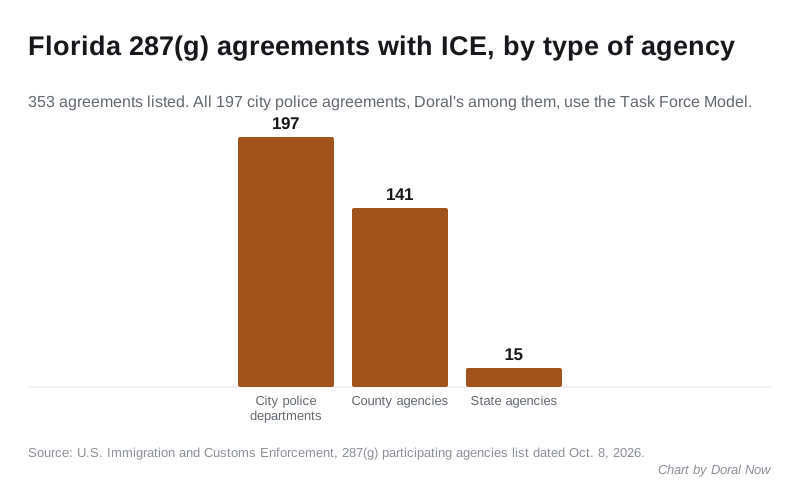
Across Florida, ICE lists 353 agreements. City police departments hold 197 of them, and all 197 use the Task Force Model.
What it means for you
The agreement covers what Doral officers may do. It does not govern federal agents, who enforce immigration law in Doral with or without it.
If you have a complaint about immigration enforcement by a Doral officer, the agreement gives these routes:
- ICE’s Office of Professional Responsibility at 1-833-4ICE-OPR (1-833-442-3677)
- email to ICEOPRintake@ice.dhs.gov
- the Doral Police Department’s Internal Affairs Division
- the supervisor of the officer involved
The public record does not yet show how many Doral officers have been certified or how many people they have processed. The agreement requires the department to keep that data. Anyone can ask the city for it through a public records request; our guide to who to call at City Hall lists the City Clerk’s office. Police items we publish are on our Police and Fire log.
Have your say